

Financial Caregiving Checklist for an Aging Parent

A financial caregiving checklist can help an aging parent stay in charge while the family gets organized. Start by asking what help, if any, the person wants; make a short map of the accounts and contacts they choose to include; use each institution’s official permission process; and set a date to revisit the plan. A checklist does not give anyone account authority, prove that fraud occurred, or replace an institution, qualified adviser, legal process, or emergency response.
This is a plan for ordinary preparation, not a test of an older adult’s independence. The useful question is not, “How do I take over?” It is, “What would make it easier for you to get the support you want?” The Consumer Financial Protection Bureau (CFPB) recommends starting financial conversations before a crisis, with attention to how a person wants to keep control of their money and property. Its planning guidance is a good source of questions to bring to that conversation.
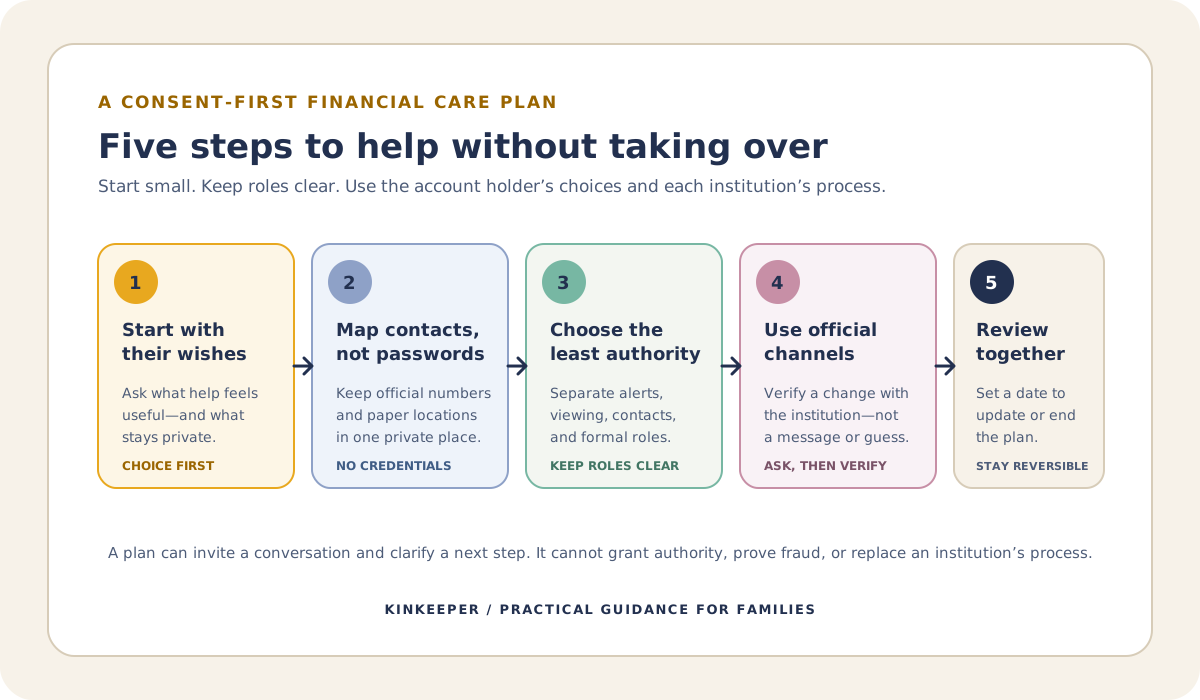
The five-step financial caregiving checklist
Use these steps with the account holder. They can decide to stop after any step, narrow the scope, or choose a different person.
1. Start with the person’s wishes, not a problem to solve
Choose a quiet moment, name one topic, and ask permission before asking for details. A first question might be: “Would it be helpful to make a simple plan for who to call if a bill or account notice looks unfamiliar?” The answer may be “not now,” and that is a valid answer.
Keep the first discussion practical and reversible:
- What kinds of help would feel useful: a contact list, a monthly check-in, a copied alert, or simply someone to call?
- Which money tasks stay entirely private?
- Who, if anyone, should join a later conversation?
- What should happen if the person changes their mind?
If the discussion feels emotionally loaded, start with the broader guide to talking with an aging parent about accepting help. It keeps the focus on choice and next steps rather than on persuading someone to give up control.
2. Make a contact map, not a shared-password file
The goal is to know where to begin, not to copy every account detail into a family chat or document. The National Institute on Aging recommends organizing important records and telling a trusted person or professional where to find them. Its getting-affairs-in-order checklist includes financial information, institution contacts, current insurance records, and the location of key papers.
With the account holder’s permission, make a brief, private map that includes only what the plan needs:
- the names of chosen banks, credit unions, card issuers, brokerages, insurers, and advisers;
- official customer-service numbers or secure-message paths found on statements or official websites;
- where the person keeps current statements, bills, tax records, and formal documents; and
- one person to contact first if the account holder wants help with a specific task.
Do not put passwords, security answers, full account numbers, or one-time codes in the map. Instead, write down where the account holder keeps their own credentials and use the institution’s documented path if another person needs a permitted role. That preserves a clear record of who is allowed to do what.
Keep the map small enough to review comfortably. A list of institutions, official contact paths, and document locations is often more useful than a complete financial inventory. If the person wants different people to help with different tasks, give each person only the contact information and scope they need. A sibling helping to update a contact list does not automatically need to see statements; a person invited to a monthly review does not automatically need authority to act.
3. Match the help to the least authority that works
“Financial caregiving” can describe very different roles. Treating those roles as interchangeable can create confusion for both families and institutions.
| If the person wants help with… | A starting question to ask | What it does not automatically mean |
|---|---|---|
| Keeping records organized | “Who should know where these papers are kept?” | Access to an account or authority to make a decision |
| Noticing a possible change | “Does this institution offer alerts or a documented view-only option?” | Proof of fraud, or permission to move money |
| A brokerage contact in limited circumstances | “Would you like to ask about a trusted-contact designation?” | Authority to trade, withdraw, or act as power of attorney |
| Someone acting for the person | “What formal authority, if any, has been set up and when would it apply?” | A family decision made without the person’s wishes, institution process, and appropriate advice |
The CFPB’s Managing Someone Else’s Money guides separate the duties of people named under a power of attorney, court-appointed guardians, trustees, and government fiduciaries. Those roles are not a do-it-yourself menu; their requirements can depend on the document, the institution, and state law.
For brokerage accounts, a trusted contact is a narrower choice. FINRA explains that a firm may contact the person in limited circumstances, including possible exploitation or difficulty reaching the customer, but the designation does not make that person a decision-maker. Read FINRA’s trusted-contact guidance before assuming that a brokerage option applies to a bank, card issuer, or another account.
4. Agree on one official response path for a change
Plans are more useful when they say what happens after a confusing notice, unusual charge, or missed bill. Keep the response proportionate: an unfamiliar item is a reason to ask and verify, not proof that a scam, abuse, or mistake occurred.
Write down a simple sequence:
- Check the date, amount, merchant, or notice against the person’s usual routine.
- Ask the account holder whether they recognize it before involving more people.
- If it still needs a response, contact the relevant bank, card issuer, or brokerage through the official number on a statement, card, or verified website.
- Record the date, institution, and next step without copying sensitive information into ordinary texts or group chats.
When the concern begins with a suspicious message, invoice, or request, ScamScan can explain common warning signs in plain language. It is educational guidance, not a verification service and not a guarantee that a message is legitimate or fraudulent. If the concern is suspected exploitation or unexplained money movement, the guide to elder financial abuse signs and reporting explains possible reporting paths and why the relevant institution should be contacted through an independently verified route.
5. Give each task an owner and a review date
One caregiver should not quietly become the family’s full-time financial gatekeeper. Divide tasks according to what the account holder chose. For example, one sibling can keep the contact map current, another can join a monthly review if invited, and the account holder can decide which alerts remain useful.
The National Institute on Aging recommends revisiting planning documents regularly and after a major life change. Use the same habit for this smaller family plan. A monthly or quarterly review can ask:
- Do these contacts and permissions still feel right?
- Has an institution changed its options or contact information?
- Does anyone need less visibility—or none?
- Is there one task that now needs an official institution process or qualified advice?
For a family also balancing work, local backup, and daily coordination, a working-caregiver plan can keep money tasks separate from everyday check-ins. Those tasks can be shared without making every family member part of a financial plan.
A review is also the moment to reduce access or retire a task that is no longer useful. The account holder may decide that a copied alert is creating more stress than help, or that a different relative should be the first contact. Treat those changes as normal maintenance. A supportive plan should be easy to narrow, pause, or replace as circumstances and preferences change.
A 30-minute first meeting agenda
The checklist is most manageable when the first meeting has a narrow purpose. Try this agenda rather than trying to organize everything at once.
| Minutes | Topic | Useful outcome |
|---|---|---|
| 0–5 | Confirm the person’s goal and boundaries | A clear “yes,” “not now,” or limited topic |
| 5–15 | List the institutions and papers they choose to include | A private contact map with no credentials |
| 15–22 | Ask what each institution allows | One official question for a bank, card issuer, or brokerage |
| 22–27 | Decide what to do if something looks different | A short verify-through-the-institution rule |
| 27–30 | Pick a review date and the person responsible for it | One next step, one owner, one date |
This is an organization meeting, not a financial assessment. Do not use it to decide that someone lacks capacity, to pressure them into a formal role, or to diagnose a change. If formal documents, authority, benefits, or a possible exploitation situation are involved, pause and use the appropriate institution, local public resource, or qualified professional.
Where read-only Money monitoring fits
A plan can include a consent-led way to notice activity without handing another person the ability to act on an account. Our guide to read-only financial monitoring for an aging parent explains the difference between alerts, view-only options, trusted contacts, and authority to act.
KinKeeper Money is designed as a read-only second set of eyes for supported Transaction Monitoring activity. It may surface activity that deserves a human conversation or closer review by a selected Kin Circle. It cannot move money, change a bank account, stop a payment, verify fraud, recover funds, or guarantee against loss. It also is not a power of attorney, guardian, trustee, bank, legal adviser, Adult Protective Services, law enforcement, or an emergency service.
The free Money Safety & Monitoring Playbook can help a family set a baseline and review a pattern without jumping to conclusions. The When the Pattern Changes research report offers additional context for separating an observation from an assumption.
Keep the plan supportive—and limited
Financial caregiving should make it easier for the account holder to get the help they chose. It should not become surveillance, a substitute for consent, or a way to bypass an institution’s safeguards. The person can narrow the plan, replace a contact, or end it.
If your family decides that a read-only review routine would be useful after making these boundaries clear, see how KinKeeper Money works. The right next step may also be a simpler one: updating a contact list, asking a bank about its process, or scheduling a calm follow-up conversation.
Sources and review
- Consumer Financial Protection Bureau: Planning for diminished capacity and illness
- Consumer Financial Protection Bureau: Guides for Managing Someone Else’s Money
- National Institute on Aging: Getting your affairs in order checklist
- FINRA: Trusted Contact Person
Published and reviewed September 1, 2026. Review by September 1, 2027, or sooner if Money availability, financial-institution guidance, or trusted-contact rules change.
Frequently asked questions
What is financial caregiving?
Financial caregiving can range from helping someone organize information or call an institution to acting in a formal role, such as an agent under a power of attorney. The right role depends on the person's wishes, the institution's process, and applicable law. It should not be assumed just because someone is family.
Does a trusted contact give me access to an aging parent's account?
No. For a brokerage account, a trusted contact is someone the firm may contact in limited circumstances. It does not give that person authority to trade, withdraw funds, change settings, or act as a power of attorney. Ask each financial institution about its own options.
Should a family share passwords to make financial caregiving easier?
No. Use the financial institution's documented access, alert, authorized-viewer, or contact process instead of sharing passwords, security answers, or one-time codes. The account holder can then understand, limit, and change the arrangement through the institution.
When should a family seek more help?
If there is a suspected scam, unexplained account activity, concern about exploitation, or a question about formal authority, contact the relevant financial institution through an independently verified channel and seek the appropriate local professional or public resource. A checklist is not legal, financial, or emergency advice.

Money safety
Bring unusual transactions into view
Join the waitlist for Money launch and product updates, or use ScamScan when a suspicious message is already in front of you.
Waitlist updates · No payment required · Unsubscribe anytime