

How to Monitor an Aging Parent's Finances Without Taking Over

Read-only money monitoring can help a family notice a change without handing over control. With the account holder’s consent, it combines a clear baseline, institution-level alerts or viewing options, and a shared plan for what to check when something looks unfamiliar. It cannot move money, prove that fraud happened, stop a payment, or replace the bank, a trusted professional, or emergency services.
For many families, the question is not whether an aging parent can manage their own money. It is how to make it easier to spot a change early without turning ordinary support into surveillance. The most useful answer is usually a small, permission-led system: the account holder decides who can see what, everyone agrees on what is normal, and an unfamiliar transaction becomes a question to verify—not an accusation.
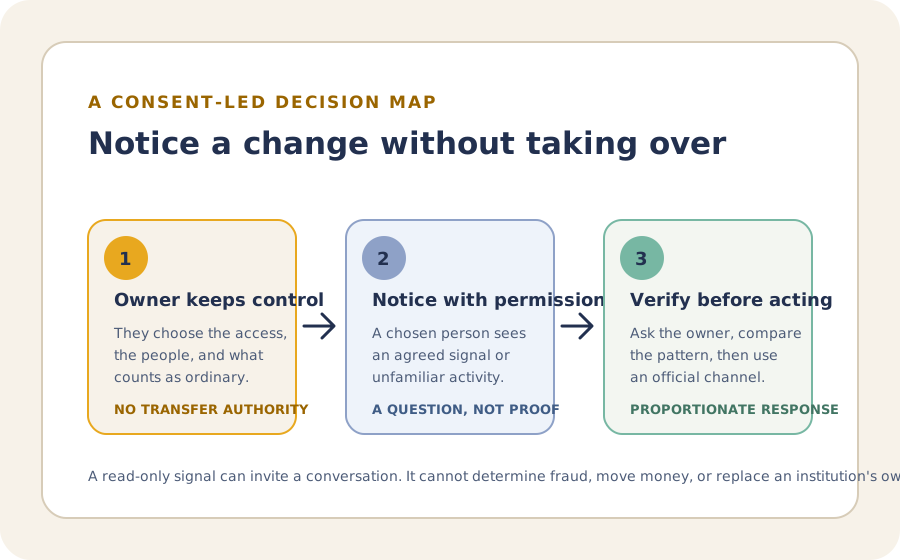
Start with the boundary: support is not control
Financial help has different levels of access. Treating them as interchangeable is how families accidentally overstep.
- Alerts tell the account holder about a transaction, a low balance, or another account event. Some institutions let the account holder choose what to receive and how.
- View-only or read-only access may let a person see activity without authorizing transfers, withdrawals, or account changes. Availability and permissions vary by bank, card issuer, brokerage, and account type.
- A trusted contact is usually a person a financial institution may contact in limited circumstances. For brokerage accounts, the SEC’s Investor.gov explanation of trusted contacts says that designation does not give the person authority to trade, transact, or act as a power of attorney.
- Authority to act, such as a power of attorney or a joint-account arrangement, is different. It can carry meaningful legal, financial, and relationship consequences. The Consumer Financial Protection Bureau’s overview of family help with bill paying and banking describes several options and is a good starting point for questions to ask an institution or qualified adviser.
Choose the least access that solves the actual problem. A family member who lives far away may only need to know that a parent has seen an alert. Someone who helps with monthly bills may need a formal institution-approved role. Neither choice should be assumed just because someone is family.
Make a permission plan before connecting anything
Start with the account holder in the room, on the call, or otherwise fully involved. A calm conversation before a problem arises gives everyone a chance to set boundaries without the pressure of a suspicious charge.
Use these five questions to create a simple plan:
- What would you like another person to help notice? Examples might include a large transfer, a new recurring charge, a payment to a new payee, or a missing expected deposit.
- Who should be able to see it? Name one person first, then decide whether another family member needs the same visibility. More people do not automatically mean more safety.
- What can that person do? Write down the boundary: view activity, receive a copied alert, join a monthly review, or only be called if the account holder asks.
- What stays private? Agree on account categories, spending details, and household information that are not part of the plan.
- What happens when something changes? Decide who asks first, how they will ask, and when the account holder or family should call the institution directly.
This is a financial version of a family check-in plan: it gives people a dependable next step without making one person responsible for watching constantly. If the conversation itself feels hard, our guide to talking with an aging parent about accepting help can help families start from choice and reversibility.
Ask each institution what its version of help allows
There is no universal family-access setting. Before sharing a login, ask the bank, card issuer, or brokerage what options it offers for the specific account. Explain that the account holder wants help noticing changes while keeping control of transactions and account decisions.
Useful questions include:
- Is there a view-only, authorized-viewer, or account-alert option for this account?
- Can the account holder choose which alerts a trusted person receives, or should alerts go only to the account holder?
- Can the account holder add or update a trusted contact, and what information may the institution share with that person?
- What is the official number or secure message path to use if a transaction cannot be explained?
- How can the account holder reduce or revoke access later?
Never solve this by sharing a password, security-answer, or one-time code. Those credentials can blur responsibility, make it harder to tell who approved a change, and may conflict with an institution’s own terms. The account holder should use the institution’s documented permission path whenever one is available.
Build a baseline: what is ordinary for this person?
Monitoring works best when it compares activity with the account holder’s own routine. Before treating anything as unusual, make a short list of expected patterns:
- recurring income, bills, subscriptions, and charitable gifts;
- travel, caregiving, home repair, or other planned expenses;
- regular cash withdrawals or transfers between the person’s own accounts;
- who normally pays which household bill; and
- transactions the account holder wants a second set of eyes on.
The point is not to catalog every purchase. It is to avoid turning a familiar expense into a false alarm. A new charge may be legitimate; an old recurring charge may be forgotten; a large payment may reflect a planned repair. A useful monitoring conversation begins, “Do you recognize this?” rather than, “Why did you do this?”
That distinction matters because official guidance treats account changes as possible signals, not proof. The SEC’s elder-fraud guidance lists unusual or unexplained withdrawals, wires, and other financial changes among warning signs, while also directing people to appropriate reporting and support channels. An unfamiliar transaction deserves a careful check; it does not establish fraud, diminished capacity, or wrongdoing by the account holder or anyone close to them.
Use a three-step response when something looks different
The family does not need a dramatic escalation rule for every surprise. Use a proportionate sequence instead.
1. Pause and compare
Check the date, amount, merchant name, and any note the account holder can see. Compare it with the agreed baseline. Do not call a number in a suspicious text or email, and do not ask a parent to share a password or one-time code.
If a message is part of the concern, ScamScan can provide a plain-language read on common warning signs. It is educational guidance, not a verification service or a guarantee that a message is legitimate or fraudulent.
2. Ask with the account holder, not around them
Bring the account holder into the review whenever possible. They may recognize a merchant, a gift, a medical bill, or a planned transfer immediately. If they want help, use the official phone number on a statement, the back of a card, or the institution’s official website together.
For brokerage accounts, a trusted-contact designation can give a firm a way to reach someone the customer chose in limited situations. FINRA explains that a trusted contact does not become a decision-maker or have authority to trade; its role is distinct from a power of attorney, guardian, trustee, or executor. FINRA’s guidance for older investors also explains that firms may use their own processes when they reasonably suspect exploitation. Those institutional safeguards are not something a family member or monitoring tool can promise to trigger.
3. Verify through the right channel
If the transaction still cannot be explained, contact the relevant bank, card issuer, or brokerage through an independently verified channel and ask what steps it recommends. Document the date, amount, merchant, and whom you spoke with. When there is suspected financial exploitation, local Adult Protective Services or law enforcement may be appropriate; state processes differ.
For a fuller response plan, read elder financial abuse: signs and reporting. If the concern is a scam request rather than an account pattern, start with our guide to protecting an aging parent’s money from scams.
Where KinKeeper Money fits—and where it does not
KinKeeper Money is designed as a read-only second set of eyes for supported Transaction Monitoring activity. It can surface account activity that may deserve review by the selected Kin Circle. It cannot move money, change a bank account, stop a payment, verify that fraud occurred, recover funds, or guarantee against loss.
That makes it a complement to—not a replacement for—the account holder’s bank alerts, statements, trusted contacts, and direct relationship with each financial institution. It also is not a legal authorization tool: KinKeeper does not become a power of attorney, a guardian, a trustee, or a decision-maker for the account holder.
If a family wants to understand the habit behind the tool, the free Money Safety & Monitoring Playbook walks through how to establish a baseline, notice a pattern, and check it without taking over. The When the Pattern Changes research report offers additional educational context. For a concise side-by-side of the boundary, read what read-only family monitoring can and cannot do.
A monthly review that preserves independence
Many families do not need daily financial conversations. A short monthly review can be enough to keep the plan current:
- Ask whether the people, alerts, and permissions still feel right.
- Review only the changes the account holder agreed to review.
- Update the baseline for travel, new bills, canceled subscriptions, or a new caregiver arrangement.
- Confirm that a trusted contact and emergency contact are still current where the account holder has chosen to provide them.
- Write down the one change the family will make before the next review.
The account holder can change their mind. They can narrow visibility, add a different trusted person, or end a viewing arrangement. That reversibility is often what makes a plan feel supportive instead of intrusive.
Financial review should not quietly become a 24/7 job for one family member. When a relative is also balancing work, use a working caregiver plan to separate a daily check-in, a local backup, and a consent-led financial review. Different people can own those tasks; the account holder still decides who sees financial details.
When monitoring is not enough
Read-only review is not a response plan for an urgent danger, a missing person, suspected abuse by someone with account access, or a legal question about authority. Use the financial institution’s official fraud or security channel, local emergency services when there is an immediate emergency, Adult Protective Services when appropriate, and qualified legal or financial advice for decisions that require it.
For routine, consent-led visibility into activity that may deserve a closer look, see how KinKeeper Money works or join the Money waitlist. The first step is still the same: decide together what the family is allowed to notice, and what the account holder wants to remain theirs alone.
Sources and review
- Investor.gov: Trusted Contact
- Consumer Financial Protection Bureau: Options for help with bill paying and banking
- Investor.gov: Elder Fraud
- FINRA: Protecting Older Investors From Financial Exploitation
Published July 21, 2026; updated July 28, 2026 for the working-caregiver internal path. Review by July 21, 2027, or sooner if KinKeeper’s Money availability, financial-institution guidance, or trusted-contact rules change.
Frequently asked questions
Can I monitor my aging parent's finances without having power of attorney?
Possibly, if the account holder consents and the institution offers an alert, authorized-viewer, or other documented option. Ask each bank, card issuer, or brokerage what is available. A brokerage trusted contact does not itself give account access, and any authority to act is separate.
What is read-only financial monitoring?
Read-only monitoring is a way to review account activity without being able to move money, change account settings, or make transactions. It can help a family notice an activity change and decide what to check next; it cannot determine that fraud occurred or stop a payment.
What should I do if I see an unfamiliar transaction?
Pause before assuming fraud. Ask the account holder whether they recognize it, check the merchant and date, and contact the bank or card issuer using the number on a statement or official website when it remains unexplained. If there is an immediate concern, ask the institution what protective steps are available.
Does a trusted contact give someone access to a brokerage account?
No. A brokerage trusted contact is someone the firm may contact in limited circumstances, such as possible exploitation or difficulty reaching the account holder. It does not give that person authority to trade, withdraw money, or act as a power of attorney.

Money safety
Bring unusual transactions into view
Join the waitlist for Money launch and product updates, or use ScamScan when a suspicious message is already in front of you.
Waitlist updates · No payment required · Unsubscribe anytime