

KinKeeper research

Preventing Falls Without Taking Over

Falls rarely have one cause, and a safer home is not built by removing an older adult's choices. This heavily sourced KinKeeper white paper explains what the evidence says about movement, health, medicines, home design, and a family role that protects independence.

Free online report and PDF. No email required.
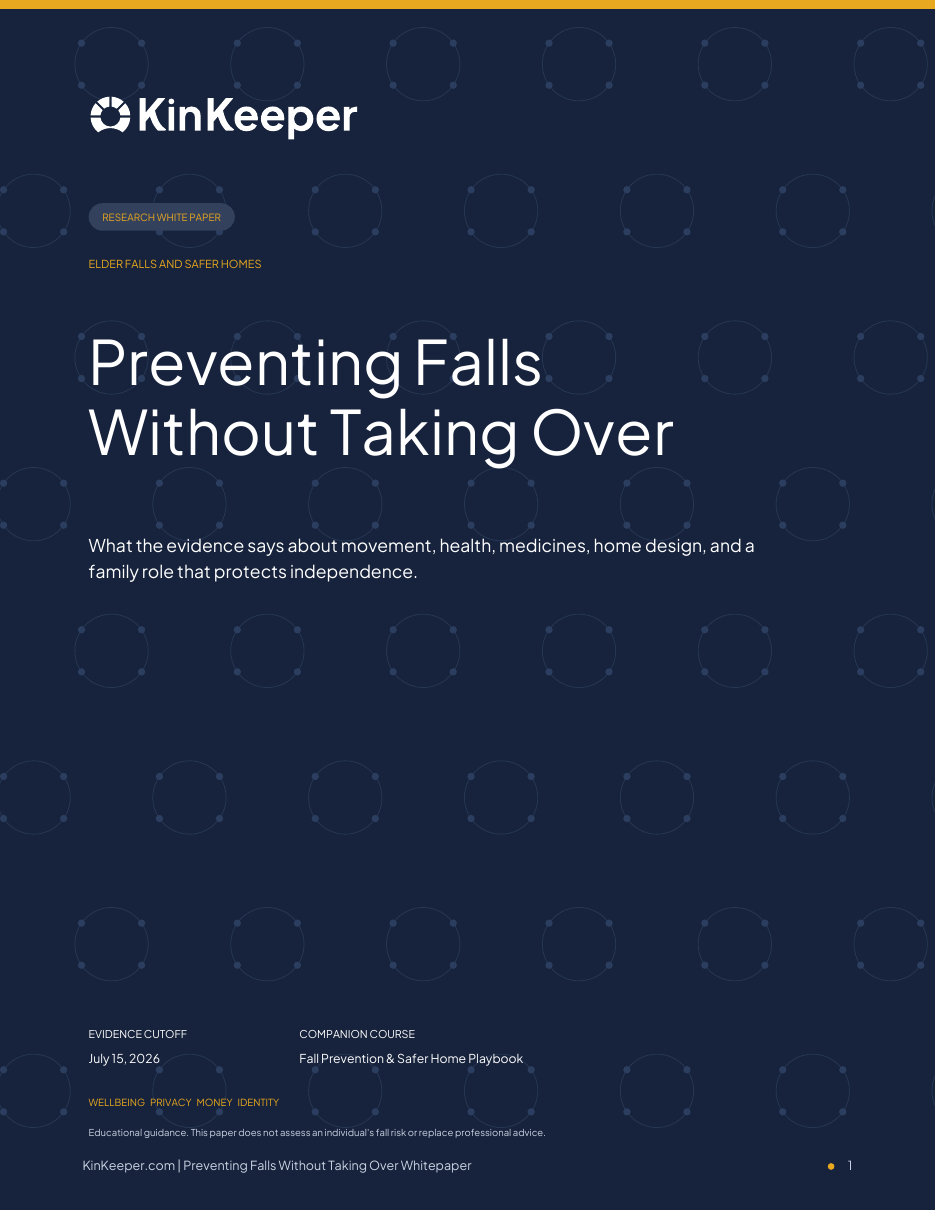
Cover of Preventing Falls Without Taking Over, a KinKeeper white paper Read online · PDF available
16numbered sources
5 fixesa practical home plan
3 layersmovement, health, home
Quarterlyevidence review cadence

What the evidence says

A safer home is one layer of a stronger response

The strongest intervention evidence supports appropriately chosen exercise for people at increased risk. Health and medicine-related changes, vision, and the home environment also matter. The paper turns those layers into a simple household method: Notice, Improve, Share.

01

Movement and confidence

Understand why appropriately chosen movement matters while keeping individual needs and professional guidance in view.

02

Health and medicines

See how vision, medicines, and health changes fit into a wider conversation without prescribing a one-size-fits-all answer.

03

Home and family support

Find practical environmental changes and a family role centered on choice, connection, and follow-through.

A practical framework

Notice. Improve. Share.

1

Notice

Look at routines, movement, medicines, vision, and the home together rather than searching for one cause.

2

Improve

Choose practical changes with the older adult, and bring clinical or home-safety questions to the right professional.

3

Share

Keep the plan visible to the people involved so support follows the older adult's choices.

Complete online edition

Read the full report

The complete research, methodology, limitations, and source ledger are published below as readable, searchable HTML.

Prefer the PDF? Open it here

Executive brief

A safer home supports independence. It is not the whole answer.

Falls are common, serious, and often shaped by more than one factor. A dim hallway may matter. So may a new medicine, a change in vision, weaker leg strength, dizziness on standing, hurried movement, or a walking aid that no longer fits. The useful question is not “Who was careless?” It is “What changed, and which part can we improve?”579

The strongest evidence in community-dwelling older adults supports exercise interventions for people at increased risk, most often using gait, balance, functional, and strength work. Multifactorial programs can also help, but their value depends on the person and the risks found. That is why a room-by-room checklist is useful but incomplete: visible hazards are one layer in a broader system.568

Notice falls, near misses, and new changes. Improve the simplest useful factor. Share the pattern with the right person. The older adult should stay part of every decision.

Three layers of a durable response

  1. Movement. Ask what strength, balance, gait, or functional activity is appropriate for the individual.
  2. Health. Share falls, dizziness, vision changes, medicine effects, and new unsteadiness with the right clinician.
  3. Environment. Make ordinary routes clearer, brighter, easier to reach, and properly supported.

The scale is national. The response is personal.

CDC reports that more than 14 million adults age 65 and older, about one in four, report falling each year. About 37% of those who report a fall also report an injury that requires medical treatment or restricts activity for at least a day. The age-adjusted fall death rate rose 21% from 2018 to 2024.1

National measureEstimate
Adults age 65+ reporting a fall each yearMore than 14 million
Older-adult fall-related emergency visits each yearAbout 3 million
Modeled 2020 U.S. spending attributable to nonfatal older-adult falls$80 billion

The spending estimate has a wide confidence interval and important modeling limitations.215

Population risk rises with age, but age does not identify why one person fell. A useful response looks for modifiable factors without treating the person as incapable.

Families should protect four things:

  • Honesty: make it safe to mention a fall or near miss before a pattern becomes a crisis.
  • Movement: do not answer fear with blanket inactivity; ask what activity is appropriate.
  • Choice: agree on one practical change together instead of redesigning a life from the outside.
  • Follow-through: visible home fixes and health concerns should reach the qualified person who can address them.

Scope and evidence

Different systems count different parts of the problem

This report keeps survey estimates, medical utilization, mortality, and modeled spending separate. They describe different years, populations, and outcomes.

  1. Self-reported falls. The Behavioral Risk Factor Surveillance System asks community-dwelling adults about falls. Estimates can be affected by recall, nonresponse, and who is not included.14
  2. Medical care. Emergency-department and hospitalization counts capture treated events, not every fall or every injury.2
  3. Deaths. National Center for Health Statistics mortality data identify falls recorded as the underlying cause of death. Rates are population measures.13
  4. Spending. The $80 billion figure is a modeled estimate for nonfatal falls in 2020, with a wide confidence interval and acknowledged confounding.15

This report treats a fall as an unplanned descent to the floor, ground, or a lower level. A near miss is not a formal surveillance category here; it is a practical signal that someone caught themselves or almost went down.

No checklist, product, course, or family routine can guarantee that a fall will not happen. The goal is to reduce avoidable risk and make a response easier.

The reported scale

Falls are common; serious outcomes are not evenly distributed

Annual fall estimates describe millions of people. Mortality rates rise sharply across older age groups, but that gradient should guide attention, not become a shortcut for judging one person’s ability.13

Age groupUnintentional fall deaths per 100,000, United States, 2023
Ages 65-7419.2
Ages 75-8474.7
Ages 85+339.5

Final 2023 data show the rate at ages 85 and older was about 18 times the rate at ages 65-74. Current CDC data also show the overall age-adjusted rate increased between 2018 and 2024.13

The annual estimates for more than 14 million people reporting a fall, about 3 million emergency visits, and about 1 million hospitalizations come from different measures. They should not be presented as stages of one funnel or one cohort.12

Why falls happen

A fall often begins where several small factors meet

The same rug may be harmless for years and become relevant when light, vision, balance, urgency, footwear, or medicine effects change. Looking across categories is more useful than looking for a single culprit.579

  • Body and movement: strength, gait, balance, feet, pain, and how a person moves through ordinary tasks.
  • Health and senses: vision, hearing, postural blood pressure, chronic conditions, cognition, and sleep.
  • Medicines and substances: dizziness, sleepiness, confusion, interactions, and alcohol-related effects.
  • Home and routine: lighting, surfaces, stairs, support, reaching, clutter, pets, weather, and rushing.

A near miss can reveal the same overlap before an injury. Ask what happened immediately before it: the route, the task, the light, the symptom, the footwear, and whether anything had recently changed.

An online report can help someone notice a pattern. It cannot determine an individual’s cause or prescribe an exercise, medicine change, walking aid, or home modification.

What the evidence supports

The clearest finding is not a gadget or a perfect checklist. It is a layered response, with appropriately chosen exercise at the center for people at increased risk.56

Movement is prevention when it fits the person

The U.S. Preventive Services Task Force recommends exercise interventions for community-dwelling adults age 65 and older who are at increased risk for falls. Across the trials it reviewed, exercise most often included gait, balance, and functional training; strength and resistance work was also common.5

The supporting AHRQ review included 37 exercise trials with 16,117 participants. Exercise had the most consistent evidence across several fall outcomes.6

Common components in the evidence include:

  • Gait and function: practice related to standing, walking, turning, and daily movement.
  • Balance: activities that challenge and improve postural control at an appropriate level.
  • Strength: resistance work that supports legs and other muscles used in daily tasks.
  • Endurance and flexibility: included in some multicomponent programs alongside balance and strength.

The safe next question is what type and level of activity fits the person’s health, current function, and fall history. Ask a qualified health professional; do not start the hardest balance routine found online.5611

Health, senses, and medicines belong in the same conversation

A multifactorial assessment can consider gait, balance, vision, postural blood pressure, medicines, the environment, cognition, and psychological health. The USPSTF recommends individualizing whether to offer this broader approach rather than treating it as an automatic package for everyone.5

  1. Share a fall or near miss. Tell a clinician about falls, repeated near misses, new unsteadiness, or fear that is changing daily activity.29
  2. Describe the change. Note when it began, what the person was doing, dizziness or weakness, and whether the pattern is repeating.
  3. Bring the medicine list. Include prescriptions, over-the-counter medicines, and supplements. Ask about side effects or interactions.912
  4. Do not change medicine alone. Do not stop, skip, add, or change a dose because of this report. Contact the prescriber or pharmacist.12
  5. Keep vision current. Regular eye care and useful lighting can make hazards and changes in level easier to see.1013
  6. Fit support to the person. A cane, walker, footwear, or therapy plan should be appropriate, correctly fitted, and used as directed.9

Dizziness, weakness, vision change, pain, and unsteadiness have many possible explanations. A list of risk factors is not a conclusion about one person’s health.

Design the ordinary route, not an imaginary perfect home

Start with what happens every day: getting out of bed, reaching the bathroom, using the stairs, carrying laundry, making coffee, and entering the home. The best first changes often make those routines easier without changing what the home feels like.89

  • Walking paths: clear cords, loose objects, and narrow detours. Secure or remove loose rugs.
  • Light: put switches or controls within reach. Light the nighttime route before standing.
  • Stairs and entries: keep steps clear. Address loose rails, uneven surfaces, and poor visibility.
  • Bathroom: use purpose-built support and nonslip surfaces; do not assume a towel rack can hold body weight.
  • Kitchen and storage: move everyday items within comfortable reach. Do not use a dining chair as a ladder.
  • Weather and outdoors: treat ice and wet surfaces as a route problem; use help or a different plan when needed.

Grab bars, handrails, electrical work, ramps, walking aids, and structural changes should be selected and installed for the person, surface, and intended use.891013

Fear can narrow a life before the next fall happens

When fear leads someone to stop ordinary activity, strength and confidence can decline. The answer is not to dismiss the fear or prescribe movement from a distance. It is to make the concern safe to share and ask what support is appropriate.29

A useful near-miss review asks:

  1. What happened? Describe the route, movement, and task without blame.
  2. What was different? Consider light, footwear, a pet, a load, urgency, illness, fatigue, or a new symptom.
  3. Has it happened before? A repeating pattern deserves attention even when no one is injured.
  4. What matters, and what change fits? Start with the routine the person wants to keep doing, then choose one acceptable improvement.

Thank the person for mentioning the event. Disclosure is a protective behavior, not an admission that someone can no longer make decisions.

Notice, Improve, Share

A household does not need a perfect plan. It needs a repeatable way to notice a change, improve the simplest useful factor, and share the concern with the right person.

A three-move household framework

The method can begin with a room, a near miss, a new symptom, or a change in confidence. It does not replace clinical screening or a qualified home assessment.716

  1. Notice. Look for the visible hazard and the new change. Ask what happened, where, and what felt different. Do not write off a near miss as clumsiness.
  2. Improve. Make the simplest useful change first: clear, light, move, secure, repair, or ask what activity fits. Do not redesign the whole home without agreement.
  3. Share. Bring in the right person for a fall, repeating pattern, symptom, medicine effect, or qualified installation. Do not quietly work around a new health change.

The order matters: notice before assuming, improve before restricting, and share before a pattern becomes harder to explain or a repair becomes unsafe to improvise.

Build a five-fix plan around real routines

Choose a short list the person is willing to make. Some actions can happen today; others need a clinician, pharmacist, physical or occupational therapist, electrician, installer, or another qualified professional.

  1. Open one daily path. Clear the route used most often. Move cords, objects, or furniture that force an awkward detour.
  2. Light the nighttime route. Put light controls within reach and illuminate the path before standing.
  3. Fix one support problem. Address a loose rail, uneven step, slippery surface, or need for purpose-built bathroom support.
  4. Move one daily item. Put frequently used objects within comfortable reach so the routine does not require climbing or twisting.
  5. Write the share plan. Name who to call about a fall, repeated near miss, new unsteadiness, dizziness, medicine effect, or vision change.

A charged phone, personal alert, or agreed daily contact can help someone call for assistance after a fall. It is a response layer, not a guarantee against injury.9

Connection without control

A worried family member can accidentally make a safety conversation feel like a loss of independence. Begin with the event, the older adult’s priorities, and one change they are willing to try.

Instead ofTry
“You cannot keep living like this.”“I’m glad you told me. Can we look at what happened?”
“I’m removing all the rugs today.”“Which route feels hardest, and what change would help?”
“You need to stop using the stairs.”“What matters most about using them, and who should assess the concern?”
“I’ll call your doctor and handle it.”“Would you like me to join you when you call?”
“Why didn’t you tell me sooner?”“Thank you for telling me now. Let’s choose the next step together.”

The family role is to make it easier to share, help with follow-through, and preserve the person’s voice. Safety and autonomy are not opposing goals when decisions are made together.7916

For clinicians and communities

Clinics, senior-serving organizations, libraries, housing groups, and community programs can reduce the burden on individuals by joining education to accessible assessment, activity, and home-safety resources.

  1. Ask clearly. Normalize questions about falls, near misses, unsteadiness, and fear. Do not wait for a fracture to start the conversation.
  2. Assess modifiable factors. Use an evidence-based clinical process for people at risk, including gait, balance, medicines, vision, blood pressure, feet, and environment.57
  3. Make referrals usable. Connect people to appropriate exercise, physical or occupational therapy, pharmacy review, eye care, and qualified home support.
  4. Measure follow-through. A handout is not an outcome. Track whether the person reached the service and whether the plan fit their priorities.

The USPSTF notes that recommended interventions must be available, accessible, and delivered equitably for people to benefit.5

If a fall happens

Slow down, check for injury, and get the right help

A fall can be startling. The National Institute on Aging advises staying calm, pausing before trying to stand, deciding whether there may be an injury, and getting help when the person is hurt or cannot rise safely.9

  1. Pause and assess. Remain still for a moment. Check for pain or injury before trying to move or stand.9
  2. Call for help when needed. If the person is hurt or cannot get up safely, use a phone or alert and call 911 for emergency help.9
  3. Treat a head impact seriously. CDC advises that an older adult who hits their head should see a doctor right away, especially because head injuries can be serious.2
  4. Tell a clinician. Report the fall even when there was no pain. It may reveal a health, medicine, vision, or mobility issue worth addressing.9
  5. Review the circumstances. After immediate needs are handled, record the route, task, symptoms, footwear, light, and recent changes.

This is general education, not first-aid training. Call 911 for an emergency. Do not attempt to lift someone if doing so could injure either person.

Put the report into practice

KinKeeper’s free Fall Prevention & Safer Home Playbook turns the report into a visual, room-by-room practice course. Learners choose five changes while keeping progress private in their browser.16

  • Chapters 1-2: Near misses and living paths. Notice a pattern and make the main route easier to use.
  • Chapters 3-4: Bathrooms, stairs, and entries. Choose purpose-built support and identify work that needs a qualified person.
  • Chapters 5-6: Night routes and reaching. Bring light and everyday items within comfortable reach.
  • Chapters 7-8: Body changes and medicines. Share new unsteadiness, vision change, dizziness, or medicine effects.
  • Chapters 9-10: Conversation and plan. Start with curiosity and build a five-fix safer-home plan.

The Playbook is free, takes about 15-20 minutes, and requires no sign-up. It is education and planning, not a clinical risk score.

Research method and limitations

How this report was researched

  1. Evidence window. Sources were reviewed through July 15, 2026. The newest final national mortality data available were for 2024 overall and 2023 by detailed age group.
  2. Source selection. Federal public-health guidance, national surveillance, the USPSTF recommendation, and its AHRQ evidence synthesis were prioritized. KinKeeper material was used only for the companion framework and course mapping.
  3. Data treatment. Self-report, medical utilization, mortality, and spending estimates were not combined. Years and populations remain close to each statistic.
  4. Clinical boundary. The report summarizes population evidence. It does not assess an individual, prescribe activity, recommend a medicine change, or specify a home installation.

Limitations

  • Self-reported falls can be undercounted or misremembered, and the main national survey excludes long-term-care residents.
  • Trial populations, intervention content, supervision, duration, and baseline risk vary substantially.
  • Evidence is most consistent for exercise. The effect of environmental or medication-review interventions alone is less certain in broad populations.
  • Risk rises with age at the population level, but the category “65+” includes people with widely different health, homes, goals, and function.
  • No educational resource can prevent every fall or guarantee that assistance will arrive after one.

The next scheduled review is October 15, 2026, or earlier if CDC surveillance, USPSTF or STEADI guidance, or the KinKeeper companion course materially changes.
Sources

  1. Centers for Disease Control and Prevention, Older Adult Falls DataFebruary 26, 2026. National surveillance summary, annual self-reported falls, and final 2024 mortality trend. Accessed July 15, 2026.
  2. Centers for Disease Control and Prevention, Facts About FallsJanuary 27, 2026. Emergency visits, hospitalizations, repeat-fall risk, disclosure, injury, and head-injury guidance.
  3. National Center for Health Statistics, Unintentional Fall Deaths in Adults Age 65 and Older: United States, 2023June 2025. Final mortality rates by age, sex, race and Hispanic origin, and state.
  4. CDC MMWR, Nonfatal and Fatal Falls Among Adults Aged 65 Years and OlderSeptember 1, 2023. National nonfatal fall prevalence, mortality, variation, limitations, and STEADI implications.
  5. U.S. Preventive Services Task Force, Falls Prevention in Community-Dwelling Older AdultsJune 4, 2024. Exercise recommendation and individualized use of multifactorial interventions for adults at increased risk.
  6. Agency for Healthcare Research and Quality, Interventions to Prevent Falls in Older AdultsJune 2024. Systematic review of 83 randomized trials; exercise had the most consistent evidence across fall outcomes.
  7. Centers for Disease Control and Prevention, STEADIUpdated 2025. Clinical framework for screening, assessing modifiable factors, and intervening.
  8. Centers for Disease Control and Prevention, Check for Safety2017. Room-by-room home hazards and practical fixes for stairs, floors, kitchens, bathrooms, and bedrooms.
  9. National Institute on Aging, Falls and Fractures in Older AdultsReviewed September 12, 2022. Risk factors, activity, home safety, medicines, vision, footwear, assistive devices, and what to do after a fall.
  10. National Institute on Aging, Six Tips To Help Prevent FallsJune 5, 2025. Guidance on medicine effects, home changes, standing slowly, strength and balance, vision and hearing, and walking aids.
  11. U.S. Department of Health and Human Services, Physical Activity Guidelines for AmericansSecond edition, 2018. National guidance including multicomponent activity and balance training for older adults.
  12. National Institute on Aging, Taking Medicines Safely as You AgeReviewed September 2022. Medication lists, side effects, polypharmacy, and the instruction not to stop prescription medicines without clinician guidance.
  13. Centers for Disease Control and Prevention, Vision Impairment and FallsMay 15, 2024. Vision-related fall risk, eye care, lighting, footwear, exercise, and medicine-side-effect considerations.
  14. Centers for Disease Control and Prevention, Falls InterventionsUpdated 2025. Evidence-based intervention resources for community organizations, public-health practitioners, and clinicians.
  15. Haddad YK, Miller GF, Kakara R, et al., Healthcare spending for non-fatal falls among older adults2024. Estimated 2020 U.S. healthcare spending attributable to nonfatal falls among community-dwelling older adults.
  16. KinKeeper, Fall Prevention & Safer Home PlaybookJuly 2026. Companion educational course and source of the Notice, Improve, Share practice framework; not used as external clinical evidence.
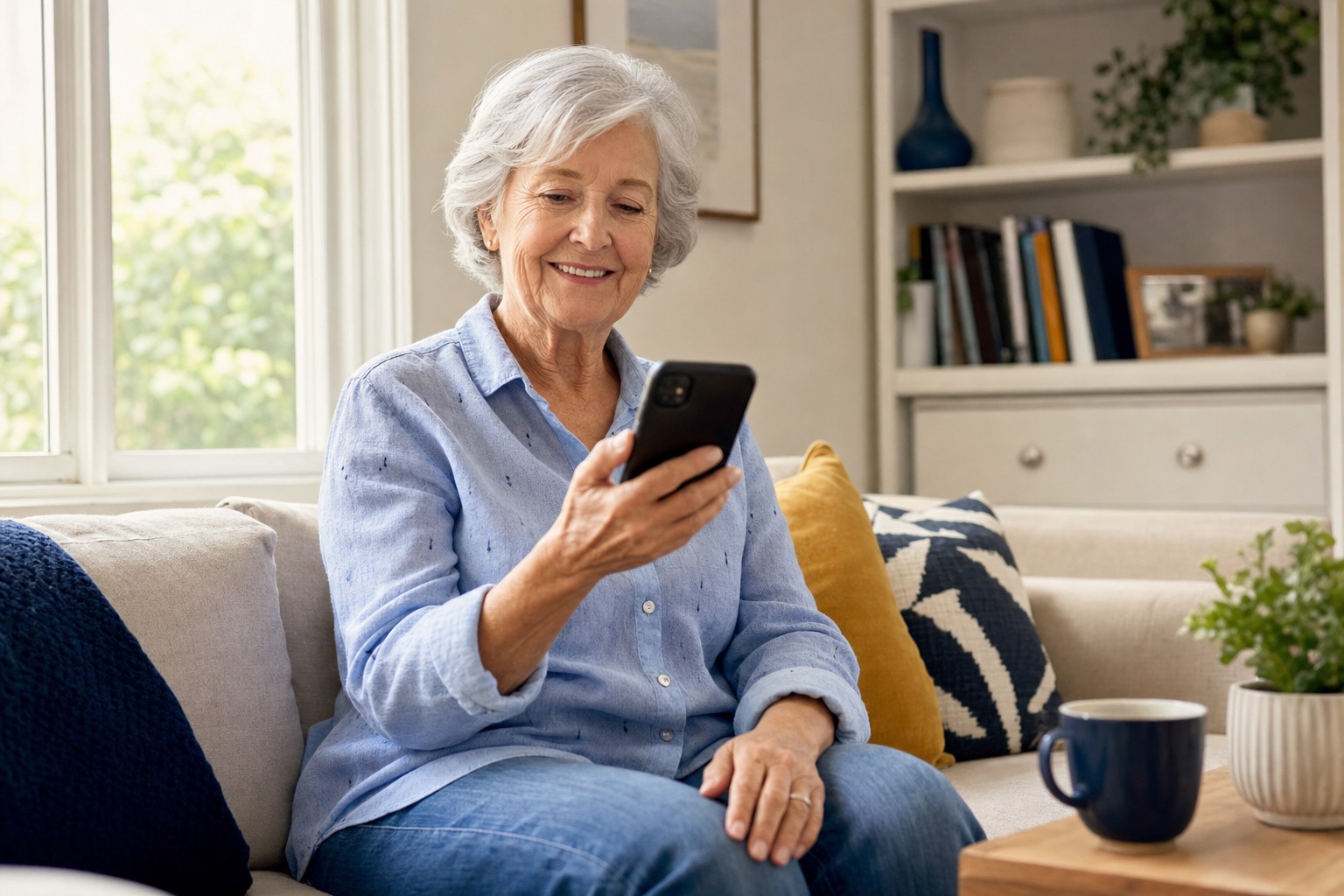
An independent older adult smiling while using a phone at home

Companion Playbook

Walk through the home before the next rushed moment

The free Fall Prevention & Safer Home Playbook uses a visual room-by-room tour to help older adults and families find easy-to-miss hazards and choose five practical changes.

  • 15–20 minutes
  • Five-action plan
  • No account required
Start the free Playbook

Keep going

Practice the next step, or bring KinKeeper into your circle.